A Kentucky child with a gift for performance
Andrew A. “Andy” Tribble was born in 1879 in Union City, a small Madison County community northeast of Richmond. Census-based accounts place him there with his mother, Alice, and his brother Amos in 1880. The family moved to Richmond around 1882, where Andy attended school.
He was a descendant of the frontier preacher Andrew Tribble. Published accounts identify Andy’s father, also named Andrew, as a grandson of the preacher .... making the performer part of a family story that stretches from eighteenth-century Baptist life to twentieth-century Black entertainment.
Andy entered show business while still a child, performing in a musical group of Black children connected with the touring production In Old Kentucky. The language then used to advertise such groups was demeaning and reflected the racial stereotypes built into American popular entertainment. Those conditions are essential to understanding both the barriers Tribble faced and the skill required to build a lasting career.
After aging out of the juvenile act, he briefly stepped away from the stage. One newspaper profile later reported that he tried working as a jockey, but abandoned that path after being thrown from a horse. He married Bessie Asbury in Marion, Indiana, on October 11, 1899. Bessie would later perform with him during his early Chicago years.
The brothers take on Chicago
In 1904, Andy and Amos Tribble began performing a comedy act together at a theater on Chicago’s State Street. At the beginning of the twentieth century, State Street was a major center of Black urban life and entertainment. The brothers’ act belonged to the expanding world of Black vaudeville, where performers created work for Black audiences while also navigating booking systems and theaters shaped by segregation.
Amos eventually left the act, but Andy continued. He moved into the circle of Chicago’s Pekin Theatre, a landmark Black-owned theater known for developing African American performers and musical productions. Early in this period he appeared with Bessie.
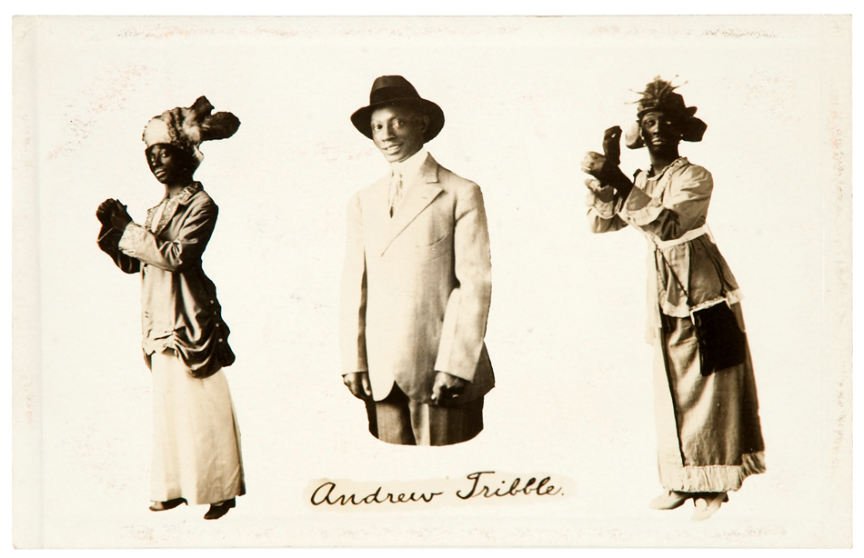
Accounts of his breakthrough say that he appeared in a dress during a performance and received an unusually strong audience response. The moment helped establish the comic female characters that would become a defining part of his career. Tribble did more than put on a costume. He built distinct personalities, studied dress closely, designed costumes and used voice, movement, timing and social observation to make each character recognizable.
Ophelia Snow, Lily White and a protean performer
Producers and performers Bob Cole and J. Rosamond Johnson saw Tribble’s work and brought him into their musical theater company. He appeared as Ophelia Snow in The Shoo-Fly Regiment, an ambitious Black musical that toured during the first decade of the twentieth century.
He followed that success with the role of Lily White, a washerwoman, in Cole and Johnson’s The Red Moon, which toured from 1908 into 1910. Contemporary Black newspapers tracked his performances and praised his comic effect. His characters were sometimes described as female impersonations, sometimes as character comedy and sometimes with the period term “protean” .... meaning an artist capable of changing form, voice and identity before an audience.
Tribble’s importance lies not only in the characters he played, but in the space he claimed as a Black comic artist shaping his own stage identity.
In 1911 he appeared with S. H. Dudley’s Smart Set, performing the character Babe Johnson alongside major performers including Aida Overton Walker. Advertising billed him as “The Colored Etinge,” a comparison with the famous white female impersonator Julian Eltinge. Eltinge reportedly praised Tribble’s talent and attention to costume. The comparison shows how highly Tribble’s craft was regarded, even as segregated theater denied Black performers equal billing, pay and historical recognition.
Tribble’s portrayals must be understood in their period. They grew from traditions of minstrelsy and vaudeville that often relied on racial and gender caricature. At the same time, scholarship on Black musical theater recognizes that performers could turn those conventions into insider comedy, gender satire and commentary aimed at audiences who understood far more than the stereotype on the surface.
Touring companies, Harlem and Broadway
Tribble continued to work nationally through the 1910s and 1920s. His career included touring companies, comedy revues and Broadway productions. He appeared in a 1924 engagement of Eubie Blake’s landmark musical Shuffle Along. By 1928 he was leading his own revue, Ophelia Snow from Baltimo’, with blues singer Clara Smith among its performers.
In 1930 he played George Brown in the Broadway musical Brown Buddies. The production opened at the Liberty Theatre on October 7, 1930, and ran into January 1931. Its cast included Bill “Bojangles” Robinson and other leading Black entertainers.
He also worked at Harlem’s Lafayette Theatre, appearing in revues including Candyland, Pep and Ginger and Magnolia Time. These appearances place him within the theatrical world of the Harlem Renaissance and the network of Black performers, writers and producers who sustained professional entertainment despite discrimination throughout the industry.
- 1904Begins a Chicago comedy act with his brother Amos.
- 1906–08Performs as Ophelia Snow in The Shoo-Fly Regiment.
- 1908–10Plays Lily White in Cole and Johnson’s The Red Moon.
- 1911Appears with S. H. Dudley’s Smart Set in New York.
- 1924Appears in a touring engagement of Shuffle Along.
- 1928Headlines Ophelia Snow from Baltimo’.
- 1930Plays George Brown in Broadway’s Brown Buddies.
- 1931Appears with Tim Moore in Oscar Micheaux’s The Darktown Revue.
- 1934Plays Flatfoot Mobly in the Broadway comedy Brain Sweat.
A surviving glimpse on film
In 1931, Tribble appeared in The Darktown Revue, directed by pioneering Black filmmaker Oscar Micheaux. In the short sound film, Tribble performs a comedy routine with Tim Moore built around a haunted-house story. The film is especially valuable because so much vaudeville performance disappeared without being recorded. It preserves movement, timing and stage chemistry that newspaper descriptions alone cannot convey.
Tribble’s association with Moore also forms an important link in popular entertainment history. Moore later became widely known for playing George “Kingfish” Stevens in the television adaptation of Amos ’n’ Andy. That documented professional connection is separate from the tradition that links the radio program’s title to Andy and Amos Tribble.
Tribble returned to Broadway in 1934 as Flatfoot Mobly in John Charles Brownell’s comedy Brain Sweat at the Longacre Theatre. That year he also appeared at the Apollo Theatre in a comedy radio sketch on a bill associated with bandleader Fletcher Henderson.
He reportedly became ill while performing in 1935 and died at his Baltimore home on October 15. He was survived by his wife Bessie, their son Atwood and four siblings. His career had stretched from a Kentucky childhood act to the nation’s most important stages.
Did Andy and Amos inspire Amos ’n’ Andy?
A Madison County tradition holds that Andy and Amos Tribble inspired the names, or perhaps elements, of the enormously popular radio program Amos ’n’ Andy. The story has been repeated in local accounts and was discussed during the 2019 dedication of Andy Tribble’s historical marker in Union City Park.
The documented chronology requires careful wording. Freeman Gosden and Charles Correll created the radio characters, originally heard under another program title, and launched Amos ’n’ Andy in 1928. Published histories do not yet establish a direct evidentiary chain from the Tribble brothers’ Chicago act to the program’s title or characters. Tim Moore’s later portrayal of Kingfish is a real connection to Andy Tribble’s professional circle, but it does not by itself prove how the show was named.
Recognition at home
In October 2019, a marker honoring Andy Tribble was dedicated at Union City Park. The commemoration returned his story to the community where it began and emphasized his importance to later generations of American comedy.
His legacy reaches beyond a single disputed radio connection. Tribble succeeded in a profession that offered Black artists few protections and limited control over how they were represented. He moved from childhood minstrelsy to Black-owned theater, national touring companies, Broadway, the Lafayette, the Apollo and motion pictures. Contemporary reviewers remembered his comic timing, carefully observed characters and mastery of costume.
Remembering Andy Tribble widens the meaning of the parsonage story. The Tribble name belongs not only to pioneer religion and frontier Kentucky, but also to African American performance, gender play, the history of comedy and the struggle of Black artists to be recognized on their own terms.
Sources and continuing research
This page combines the local research archive assembled by the Rev. Dr. Rusty Rechenbach with theater databases, university reference collections, historic newspapers and modern reporting. Additional documents from Dr. Rechenbach’s files can be added as scanned exhibits.
- WEKU, “Marker Dedicated to Vaudevillian Andrew Tribble in Madison County,” 2019
- University of Kentucky, Notable Kentucky African Americans Database
- Internet Broadway Database, Andrew Tribble
- Playbill Vault, Andrew Tribble
- WorldCat record for The Darktown Revue
- Historic reporting in The Freeman, New York Age, Indianapolis Recorder, Afro-American and other Black newspapers.